India’s electrification push is accelerating, but it is constrained by high upfront costs, weak grid and charging infrastructure, and policy uncertainty—even as schemes like FAME, PM E‑DRIVE, PLIs, and state EV policies provide strong support on the demand and manufacturing side. Some current and recent policies help electrification directly, while others (or their gaps) create friction through stop‑start subsidies, slow grid reforms, and regulatory bottlenecks.
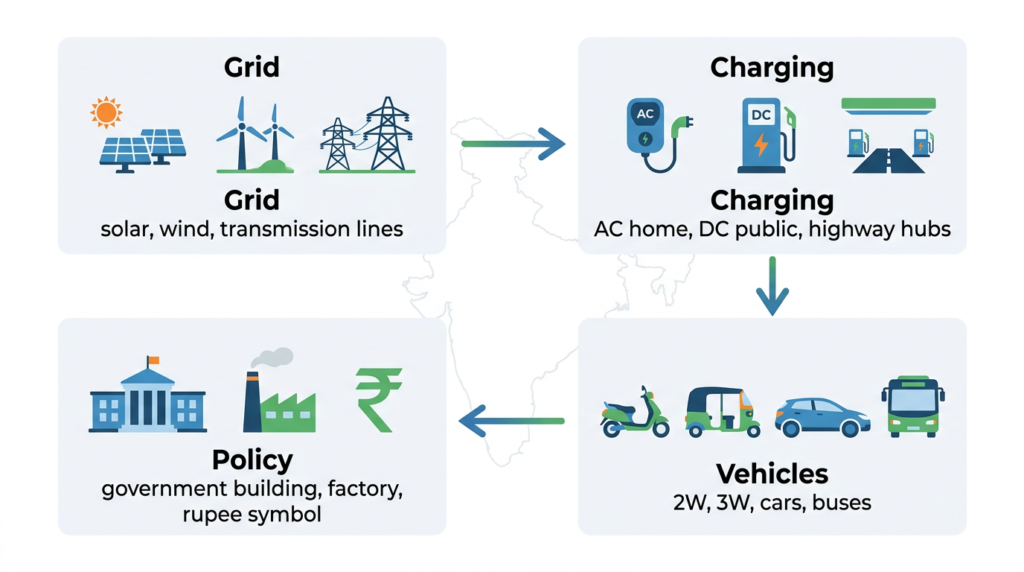
What “electrification” means here
In the Indian context, electrification is really two linked transitions:
- Shifting road transport (2W, 3W, buses, cars, freight) from ICE to EVs.
- Decarbonising and expanding the power system so those EVs are fed reliably by a greener grid.
India is targeting around 30% EV penetration in private cars and much higher levels for two‑wheelers, three‑wheelers and buses by 2030, which implies a big jump in both vehicle sales and clean electricity supply.
Market‑side challenges for EV adoption
Key India‑specific demand‑side challenges are:
- High upfront cost and price‑sensitive customers
Most Indian buyers are extremely price‑sensitive, and two‑wheelers and small cars dominate the market, so even after subsidies, EVs often have a higher sticker price than ICE equivalents. Range and charging advantages are long‑term, while the price pain is immediate, which slows adoption beyond early adopters and fleet buyers. - Limited awareness and range anxiety
Many potential buyers are still unsure about real‑world range, battery life, resale value, and total cost of ownership, especially outside metros. This is amplified by uneven charging density, pushing people back to ICE for “peace of mind” on longer trips. - Product mix and financing constraints
EV penetration is highest in 2W and 3W, but private cars and heavy vehicles—which matter a lot for oil demand and urban air quality—remain a small share. Affordable financing and leasing models for EV fleets are still evolving, and many banks view EVs as higher‑risk assets compared to established ICE categories.
Infrastructure and grid challenges
Even if demand is strong, infrastructure and grid physics can limit electrification speed.
- Sparse and uneven charging network
Despite rapid growth, public charging remains concentrated in big cities and on a few main corridors; rural and small‑town India is still largely uncovered. Low utilisation of many early chargers hurts operator economics, which in turn slows private investment in new stations. - Transmission and distribution bottlenecks
India’s renewable build‑out is outpacing transmission upgrades in some regions, leading to congestion and curtailment of solar and wind during peak hours. Industry studies warn that fragmented approvals, regulatory overlaps, and delayed transmission lines could become “the weakest link” in India’s energy transition if not fixed. - Balancing variable renewables with rising EV load
High‑renewable scenarios to 2030 are technically and economically feasible, but they require more storage, flexible thermal capacity, and smarter dispatch to handle variability and new EV loads. Without these, large‑scale EV charging can add stress at peak times and at weak nodes in urban distribution networks.
Industrial and supply‑chain challenges
- Battery import dependence and cost
India still imports most lithium‑ion cells, which raises costs and exposes the ecosystem to global supply shocks. Domestic cell and component manufacturing is ramping up under PLI, but localisation is incomplete and recycling ecosystems are nascent. - Technology and skills gap
Automotive leaders highlight limited local R&D, shortage of skilled EV technicians, and gaps in safety/testing capacity as constraints on scaling high‑quality EVs and charging systems. This can slow approvals, after‑sales service quality, and thus consumer confidence.
Policies that strongly support electrification
Several central and state policies are clear positives:
- FAME II (2019–2024)
The FAME II scheme provided purchase subsidies for e‑2W, e‑3W, e‑4W and e‑buses and support for public charging, with a total outlay of about ₹11,500 crore over five years. It directly reduced upfront prices and catalysed early adoption in fleet, 2W and public transport segments. - PM E‑DRIVE (from late 2024)
To maintain continuity after FAME‑linked schemes ended in September 2024, the government launched the PM Electric‑Drive Revolution in Innovative Vehicle Enhancement (PM E‑DRIVE) scheme with an outlay of about ₹10,900 crore for two years. It targets support for roughly 25 lakh e‑2Ws, 3 lakh e‑3Ws, and 14,000 e‑buses, and also subsumes earlier EMPS incentives for small vehicles. - Production‑Linked Incentives (PLIs)
PLIs for automotive components and advanced chemistry cell batteries have expanded sharply (budget increases of several hundred percent), aiming to anchor domestic manufacturing and reduce import dependence. This directly supports localisation of EV drivetrains, cells, and packs, which should bring down costs over time. - New EV / import‑duty policy (2024 onwards)
A new EV policy reduces import duties to around 15% for companies willing to commit at least about USD 500 million in investment and local manufacturing, balancing consumer access to advanced imported EVs with domestic value‑addition. This is designed to attract global players while protecting and upgrading local industry. - State EV policies and scrappage‑linked incentives
Many states have their own EV policies with extra purchase incentives, tax waivers, and charging mandates, and new versions keep emerging. Delhi’s EV Policy 2.0, for example, links the highest incentives to scrapping BS‑IV or older ICE vehicles, keeps 100% road‑tax and registration waivers for EVs up to ₹30 lakh, and mandates at least one public charger at every vehicle dealership, with a target of about 18,000 chargers by end‑2026. - Broader power‑sector and RE targets
Central plans to expand the transmission network to roughly 650,000 circuit‑km by FY32 and integrate upwards of 450–500 GW of renewables by 2030 directly underpin “clean” electricity for EVs. Studies show such high‑renewable grids can be cost‑effective if paired with appropriate storage and grid reforms, which in turn makes large‑scale electrification more environmentally meaningful.
Policies and policy gaps that act as hindrances
Alongside these supports, several policy features or gaps slow electrification:
- Stop‑start and narrow subsidy design
The transition from FAME II and EMPS to PM E‑DRIVE involved changes in subsidy levels and scheme design, which created short‑term uncertainty for OEMs and dealers, especially on 2W pricing. Industry voices frequently highlight “policy inconsistency” and short scheme horizons as dampening long‑term investment confidence in products and charging infrastructure. - Limited focus on private 4W and freight
Most central demand incentives are concentrated on 2W/3W and buses, with more modest or indirect support for private cars and freight vehicles, even though they are crucial for oil‑import reduction and urban air quality. This creates a policy skew towards certain segments and leaves middle‑class car buyers and truck operators with weaker economic signals to switch. - Grid and transmission reform lagging investment needs
Industry reports and expert studies argue that regulatory overlaps, slow approvals, and non‑standardised procurement in the transmission sector risk making the grid the bottleneck of the energy transition. Without faster reforms, India could end up with large renewable capacity that cannot be fully evacuated or balanced, which undermines the environmental gains from transport electrification. - Unclear, evolving rules at the EV–power interface
Stakeholders cite ambiguity or complexity around tariffs for public charging, demand charges, rooftop solar plus EV charging at buildings, and revenue models for DISCOMs, all of which affect the business case for charging infrastructure. Where building codes require EV‑ready parking or wiring, enforcement is uneven, especially outside top metros. - Protectionism vs. openness balance still being tested
While the new EV import policy opens a window for global players willing to commit large local investments, India has historically used high tariffs to protect local manufacturers, which limited consumer access to some global EV models. Getting this balance wrong in either direction can either slow consumer adoption (too protectionist) or discourage domestic value addition (too open without localisation requirements).
India is meeting current EV component demand largely by importing high‑value parts like battery cells, magnets, and advanced power electronics—mainly from China—while doing more of the mechanical parts and final vehicle integration locally. There is not a “lack of engineering talent” in an absolute sense, but there is a sizeable technology and skills gap in critical areas such as battery cells, wide‑bandgap power electronics, and EV‑specific systems integration, which slows localisation.
How India is fulfilling EV component demand
Batteries and cells (biggest dependency)
- India still imports almost all lithium‑ion battery cells, despite the ACC battery PLI scheme that targeted 50 GWh of local cell capacity by 2025; as of late 2025 only around 1.4 GWh had actually been commissioned, and dependence on imported cells remains “close to 100%.”
- A large share of these cells and packs come from China: estimates suggest 60–70% of key EV components, including cells and magnets, are sourced from China, and batteries and magnets worth over USD 7 billion were imported from China in the last five years.
Motors, magnets, power electronics
- Critical inputs for motors—especially rare‑earth permanent magnets—are also almost fully import‑dependent; India imported about 2.3 kilotons of rare‑earth magnets in 2024, around 65% from China, and demand is expected to nearly triple by FY30.
- Controllers, BMS units, and advanced power semiconductor devices (SiC, high‑end MOSFETs, etc.) are similarly dominated by imports, again heavily from China and Taiwan, because India lacks large‑scale, vertically integrated manufacturing in these segments.
Other components and vehicle assembly
- On the other hand, India has a strong legacy auto‑component industry: housings, harnesses, castings, chassis, body parts, and many conventional components are already produced locally at scale, and these capabilities are being adapted for EVs.
- Many “Made in India” EVs today are therefore assembled in India with imported hearts: the battery cells, magnets, and some power electronics are imported, while the pack assembly, vehicle integration, body, and much of the mechanical content are local.
Government push to localise
- The PLI‑ACC scheme (₹18,100 crore) and auto‑component PLIs are meant to build domestic cell and component manufacturing, but progress has been slower than planned—only a small fraction of the intended cell capacity is live, and many EV models still fail to meet localisation thresholds for PLI benefits.
- New investments and gigafactory announcements under these PLIs show that localisation is starting (several states are emerging as battery hubs), but the ecosystem is still in early stages compared to East Asia.
Is there a lack of engineering technology in India?
Skills and technology gaps
- Studies estimate that less than 3% of the current automotive workforce has exposure to EV‑related technologies; the majority of engineers are still trained around ICE powertrains, not batteries, power electronics, or software‑defined vehicles.
- Commonly cited gaps include limited hands‑on training in battery systems, BMS design, fast‑charging interfaces, CAN‑based communication, regenerative braking, and wide‑bandgap devices (SiC/GaN)—most of this is taught theoretically, with minimal lab exposure.
- A Nature study notes that India’s EV manufacturing metrics lag behind global leaders, and shows that adoption of advanced manufacturing (automation, robotics, Industry 4.0) plus focused workforce development significantly boosts quality and productivity.
Ecosystem and infrastructure, not raw talent
- Research on EV battery localisation highlights that India has strengths in chemicals, software, and conventional auto manufacturing, but needs deeper backward integration into high‑value cell components and specialised equipment manufacturing to really capture the value chain.
- Testing and certification infrastructure is still thin—for instance, as of 2024 only one accredited agency in India was fully ready to test cells under the PLI‑ACC scheme, underlining institutional and equipment gaps around the technology.
Evidence that capability exists and is growing
- At the same time, there are clear signs that India can do high‑end EV engineering: recent milestones include fully indigenously developed electric two‑wheelers with in‑house battery and BMS technology that meet rigorous safety and durability standards, showing end‑to‑end capability from cell to vehicle on specific platforms.
- Indian startups and OEMs are actively innovating in BMS, fast‑charging solutions, connected telematics, and high‑performance e‑2Ws, and collaborations between companies like Ashok Leyland and IIT Madras are being used as examples of workforce‑upskilling that measurably improve advanced manufacturing competencies.
Net picture
So, today:
- Demand fulfilment is a hybrid—India is strong on vehicle assembly and many mechanical components, but relies heavily on imports for critical EV hardware, especially cells, magnets, and advanced power electronics.
- Engineering technology is not absent, but the depth and scale in key EV domains (cells, magnets, SiC/GaN power electronics, high‑volume automated production, and EV‑specific skills) clearly lags China, Korea, and some Western players, which is exactly what current PLI and skilling programmes are trying to close.
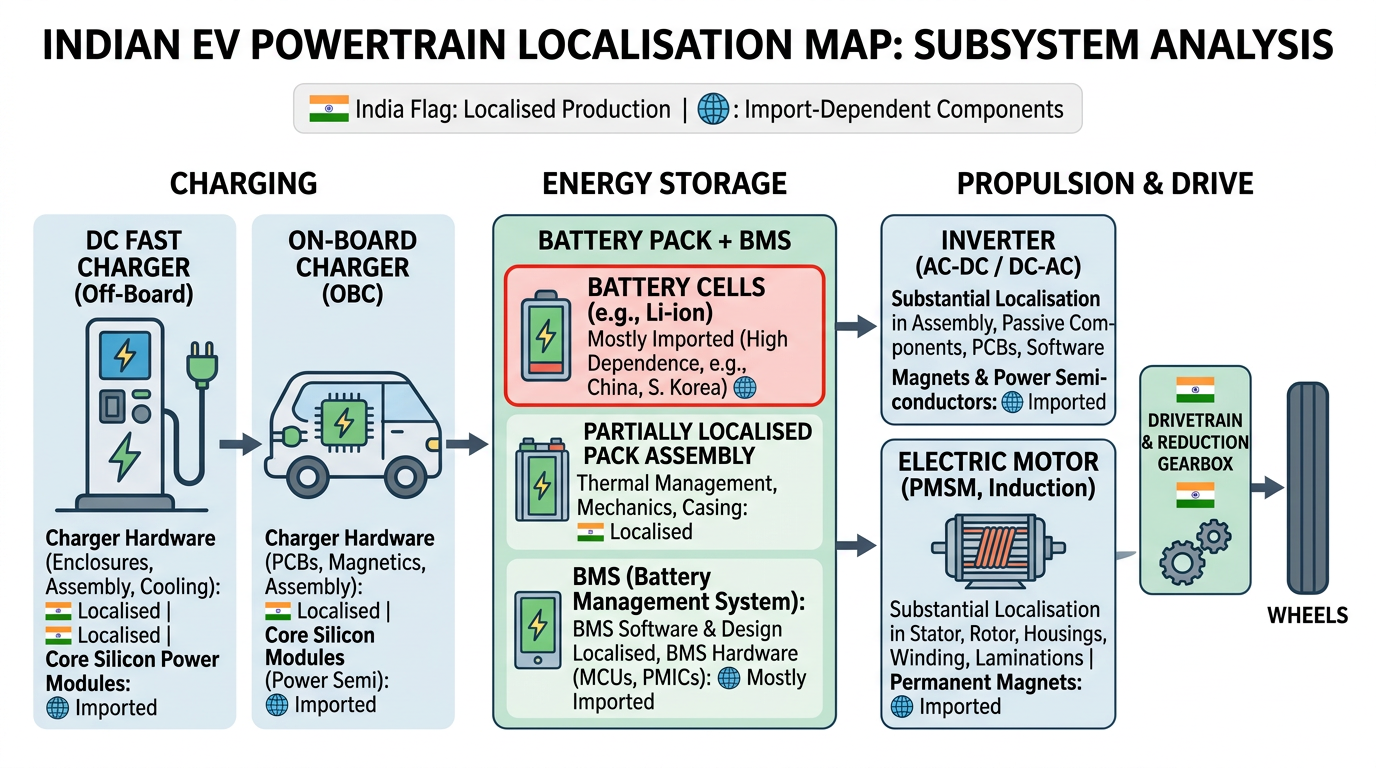
If you want, I can break this down specifically by subsystem (battery pack + BMS, motor drive, on‑board charger, DC fast charger) and map where India is importing vs already capable of designing/manufacturing, which might tie nicely into your own EV charger/PSFB content.
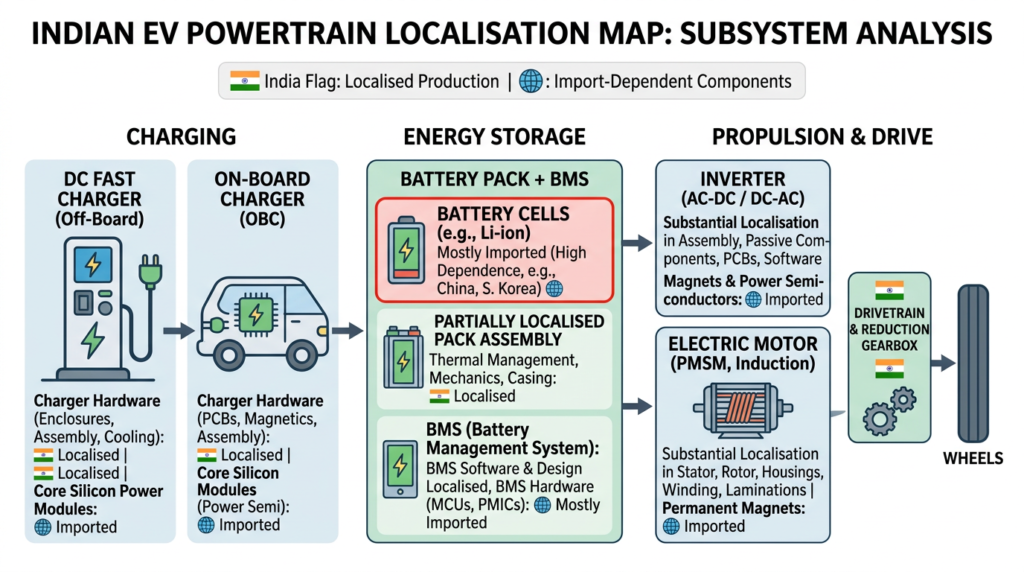
Here’s a subsystem‑wise picture of where India is importing vs building locally, and where the real engineering gaps lie.
Battery cells, packs and BMS
- Battery cells (core chemistry)
Battery cells are India’s weakest point: under 5% of EV cells are made domestically; roughly 95% are imported, mostly from China, Korea and a few other East Asian suppliers. The PLI‑ACC scheme targeted 50 GWh of cell capacity, but actual commissioned capacity by early 2026 is only a small fraction of that, so current demand is still met almost entirely by imports. - Battery packs/modules (mechanical + integration)
Pack/module assembly is much stronger: estimates put localisation at roughly 60% by value, with Indian companies handling mechanical design, pack layout, thermal management, wiring, and integration. Gigafactory plans by Reliance, Ola, Amara Raja, JSW‑MG etc. are specifically to expand local pack and eventually cell manufacturing. - BMS hardware and algorithms
Many startups and OEMs now design their own BMS boards and firmware in India, but BMS ICs and specialised chips are still heavily imported. The high‑value part of the BMS (ASICs, precision sensing, functional‑safety‑certified controllers) is dominated by global semiconductor vendors; local value is in PCB design, firmware, SOC/SOH algorithms, and integration into the pack.
Engineering gap here:
- Deep cell chemistry know‑how, materials processing, formation equipment, and cell manufacturing lines.
- High‑reliability, ASIL‑compliant BMS IC design and local semiconductor ecosystem.
India has good pack‑level and BMS‑firmware skills, but lacks full stack capability from raw materials to cell and key ICs.
Motor, inverter and drivetrain
- Traction motors
For 2‑wheelers and 3‑wheelers, localisation is high: estimates put electric motors around 70% local by value, with many Indian firms producing BLDC and PMSM machines for scooters and e‑rickshaws. Several companies (e.g., EMF Innovations, Shakti Pumps) run dedicated plants for traction motors and controllers with substantial capacities.
For high‑performance PMSM motors used in cars and heavy commercial vehicles, India still imports a significant share, especially when rare‑earth magnets and very tight efficiency/torque specs are required. - Inverters and motor controllers
Controllers/inverters are estimated at ~55% localisation: PCB design, assembly, thermal/mechanical design, and overall control firmware are often done in India, but IGBT/SiC modules, driver ICs and key semiconductors are imported. - Magnets and materials
Rare‑earth permanent magnets for high‑efficiency motors are still heavily import dependent; a large share comes from China and a few other countries, and demand is projected to nearly triple by 2030.
Engineering gap here:
- Advanced electromagnetic design for high‑end PMSM/axial‑flux machines.
- Local rare‑earth magnet production and high‑power inverter semiconductor fabs (IGBT/SiC).
Mechanical motor engineering is strong; the missing pieces are materials and semiconductor depth.
On‑board chargers (OBC) inside vehicles
- Current localisation status
On‑board chargers for 2W/3W and passenger cars are increasingly being designed and assembled in India; DIYGuru’s localisation study lists “chargers (AC/DC)” at ~65% localisation by value, with multiple local companies building OBC and small DC converters.
The power topology, magnetics, control firmware and protection design are often handled by Indian engineering teams, especially for 3.3–7.4 kW OBCs used in two‑wheelers and compact cars. - What is still imported
High‑frequency magnetics cores, high‑end MOSFET/SiC devices, controller ICs, and some safety‑critical power modules are still major import items. Many OBC “designs” are actually adapted reference designs from global chip vendors, with customisation done locally.
Engineering gap here:
- Native, from‑scratch design of high‑efficiency OBC platforms using SiC/GaN with full EMI/EMC optimisation and global certification.
- Local production of key semiconductors and magnetics.
From a power‑electronics engineer’s perspective, India has enough capability to design and produce robust 3.3–7.4 kW OBCs, but relies on foreign silicon and some core IP blocks.
DC fast chargers and public EVSE
- Local manufacturing footprint
India actually looks strong at the charger level: a number of companies manufacture AC and DC chargers domestically, including Bolt.Earth, Tata Power EZ Charge, Delta India (local plant), ABB India, Plugzmart, TeslaVolts and others.
Products span from 3.3–7.4 kW AC wallboxes to 25–50 kW urban DC chargers and up to 200–350 kW highway chargers; some Indian firms even export these chargers and build high‑power DC lines (e.g., TeslaVolts up to 300 kW). - Imported content inside chargers
Behind the “Made in India” label, many key modules—high‑power rectifier bricks, SiC/IGBT power stacks, control ICs, high‑voltage contactors, and sometimes entire PEBBs (power electronic building blocks)—are imported.
Standards compliance (CCS2, Bharat DC, Type 6/7, OCPP) and system integration (billing, connectivity, software) are done locally, but core silicon and some high‑reliability HV components are foreign‑sourced.
Engineering gap here:
- High‑power, high‑reliability DC module design and local semiconductor manufacturing.
- Long‑term field‑proven designs at 150–350 kW with full grid‑integration capabilities (V2G, advanced grid support).
System‑level EVSE design capability is solid and growing; the weak spot is vertical integration into critical power hardware.
Vehicle control units, electronics and software
- Control units and ECUs
WRI and other analyses note that battery cells, electronic control units, and BMS remain predominantly imported, even as chassis and some control units are made locally. OEMs assemble ECUs in India, but the microcontrollers, ASIL‑certified chips, ADAS SoCs, and some safety‑critical software stacks are imported from global suppliers. - Telematics, apps and fleet management
Here, India is relatively strong: fleet‑management platforms, telematics units, cloud backends, and user apps for EVs and chargers are widely developed in India and exported. The constraint is less “engineering” and more hardware cost and connectivity robustness.
Engineering gap here:
- Indigenous design of high‑end automotive‑grade MCUs/SoCs and safety‑certified SW stacks.
- Large‑scale validation, model‑based development, and certification infrastructure for complex EV control systems.
Big picture for an engineer or content‑creator
Putting it all together:
- Strong local capability
- Mechanical systems, pack enclosures, harnesses, chassis, suspension, housings.
- 2W/3W motors and controllers, mid‑level inverters, OBC and low‑to‑mid‑power chargers.
- System integration, BMS firmware, telematics, charger software, backend systems.
- Still import‑heavy / tech‑gap areas
- Battery cells and key battery materials.
- Rare‑earth magnets, high‑end PMSM motors.
- Power semiconductors (IGBT/SiC/GaN), BMS and ECU ICs, automotive‑grade MCUs/SoCs.
- High‑power DC building blocks and some safety‑critical HV components.
These are exactly the zones where India has an engineering challenge and a business opportunity—both in terms of R&D (new topologies, control, materials) and in building local manufacturing capabilities. If you want, we can zoom into just chargers and power electronics and map: which parts of a 30–150 kW DC charger stack are realistic to design/make in India today, and which are “must‑import” in the short term.
EV charger manufacturers in India (with localisation)
These companies manufacture AC/DC chargers in India (not just operate networks), often with local enclosure, PCB assembly, firmware and system integration, while importing power semiconductors and some HV parts.
Major charger manufacturers
Pattern: system‑level charger manufacturing and integration is well established in India, but fast‑charger power stacks, SiC/IGBT modules and some protection components are still imported.
Motor, inverter and motor‑controller manufacturers in India
This is where a lot of localisation is happening: motors, inverters, and motor controllers for 2W/3W especially are increasingly engineered and made in India, while semiconductors, magnets and some high‑end PMSM hardware remain import‑heavy.
Powertrain / controller manufacturers (largely indigenous)
OEMs and diversified players with in‑house controllers
Several OEMs and diversified industrials also design or assemble motor controllers and inverters as part of their EV business:
- Electra EV – Powertrain firm associated with Tata; develops controllers and complete powertrains for passenger vehicles and commercial EVs.
- Greaves Cotton – Produces motor controllers for 2W/3W as part of its e‑mobility portfolio.
- Amara Raja (Amara Raja Group) – Expanding into EV powertrain electronics, including controllers, alongside batteries.
- Bosch Limited (India) – Supplies motor controllers and inverters to Indian OEMs, largely using global technology with Indian application engineering.
- Delta Electronics India – Besides chargers, offers inverters/controllers for EV applications, assembled and adapted locally.
Who is explicitly “localising”?
Most of the above are part of the localisation push, but a few names are repeatedly highlighted in localisation/“Make in India” studies:
- Tata Motors + Tata AutoComp, Mahindra Group, Ashok Leyland – OEM–supplier ecosystems cited as building local supply for motors, inverters, thermal systems and chargers for passenger vehicles and buses.
- Sona Comstar, Virya Mobility, Elecnovo, EMF Innovations, Sterling Gtake, Physics Motors, Konmos, Shakti Pumps – Specifically described as indigenous or “first local” manufacturers of motors and controllers, aiming to replace imports for 2W/3W/LCV segments.
- Exicom, Servotech, Plugzmart, Okaya, Bolt.Earth, ChargeZone, Tata Power EZ Charge – Identified as domestic charger manufacturers scaling local production, with localisation at charger/system level and a stated goal of reducing import content over time.